Wednesday, April 5, 2006

Mass. lawmakers health insurance mandatory

Nearly 46 million Americans live without health coverage in the U.S. Yesterday, Massachusetts joined a growing number of states to tackle heatlh insurance issues in the absence of national leadership on the issue.  Massachusetts lawmakers overwhelmingly approved an ambitious health-care bill on that would make it the first U.S. state to require nearly all residents to be insured or face penalties.Under the legislation, which is expected to be approved by Massachusetts Governor Mitt Romney, insurance agencies would expand health care coverage by offering state-subsidized, low-cost insurance plans with scaled-back benefits.

The 145-page Massachusetts legislation was passed by the Democrat-controlled House in a 155-2 vote and unanimously approved by the state Senate.The Massachusetts policy provides insurance to the lowest-earning residents by offering low- or no-cost plans, with premiums and co-payments paid entirely by the state.

This approach to a program of universal health coverage builds on ideas advocated by Ted Halstead of the New America Foundation in a 2003 New York Times Editorial

Read the full article . . .

Monday, April 3, 2006

The reality of global warming and some innovative local responses

TIME Magazine made the reality of global warming the cover story of their April 3rd issue and The Aspen Skiing Company and Environmental Foundation Director Auden Schendler received kudos for their efforts in the "Climate Crusaders" section.

The whole Roaring Fork Valley probably deserved some ink given the work of the Community Office for Resource Efficiency, Solar Energy International, Rocky Mountain Institute, Rising Sun, Aspen Global Change Institute, as well as all the local governments in the region that have purchased wind power. Add Pitkin County's Renewable Energy Impact Program, Aspen's Canary Initiative, and Carbondale's Green Rec Center and TIME could put the whole valley on their next cover with the caption "Locals get serious about energy in a warming world."

Monday, March 27, 2006

Costco in Gypsum?

Costco recently filed a building permit application with the Town of Gypsum for a 159,000-square-foot retail center in the Airport Gateway Commercial Park.
The big-box retailer has been able to slip relatively quietly into Gypsum is because the zoning is already in place at the Airport Gateway Commercial Park. The location is also not right in someone's neighborhood or in an open space entrance to town.

The economic development agreement calls for the town to rebate 38 percent of the sales tax that Costco generates for three years; or until a $4.2 million cap is reached - whichever comes first. If the revenue cap isn't met in three years, the town will rebate 15 percent of the sales tax for an additional two years.

The Town estimated that in Costco's first years of operation, Eagle would get about $230,000 annually in sales tax, and Gypsum would get $350,000 in addition to the sales tax revenues that are committed or rebated.

Costco will pay for traffic lights at Highway 6 and Cooley Mesa Road - estimated cost is $500,000 - and for several hundred linear feet of improvements to Highway 6. Costco will hire 200-300 employees, which will make it the second largest employer in Gypsum. The school district is the biggest employer in the town.

This is the first time Costco has come to a community with less than 150,000 residents. Currently, the closest Costco is in Denver.

Read the full article in the Post Independent . . .

Photo from NY Times article on Costco

Garfield housing becoming less and less affordable

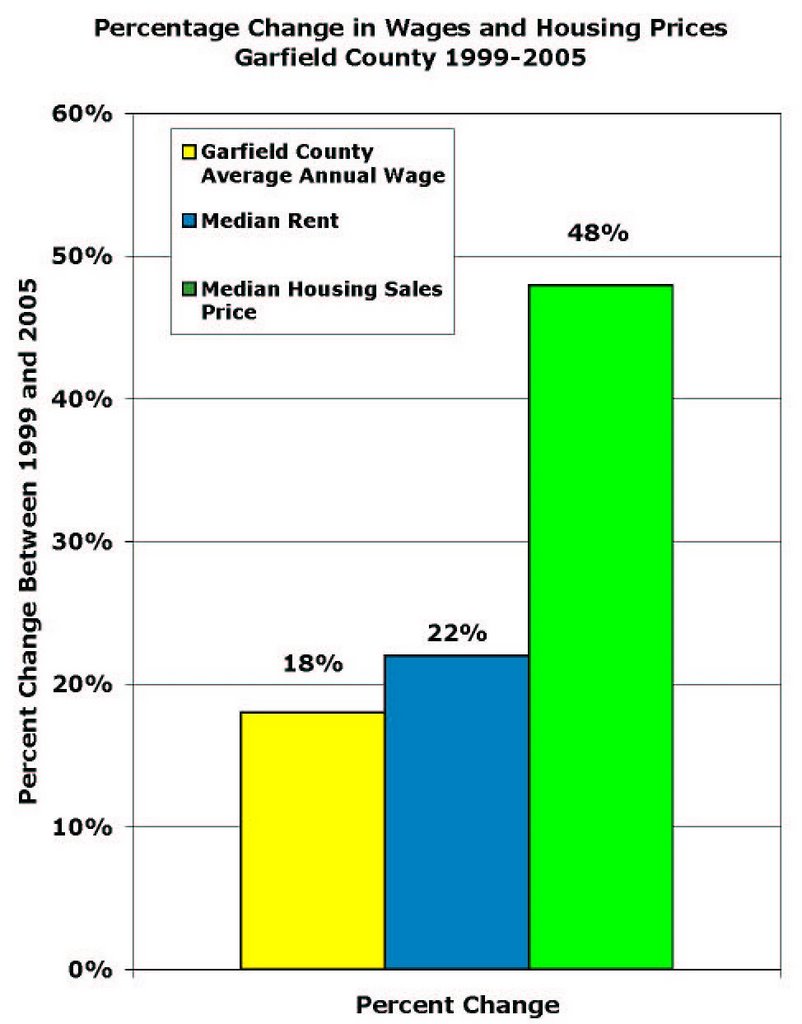
The days of Garfield County being the "affordable housing stock" for Pitkin County could be coming to a close. A recently released study by the Garfield County Building & Planning Department shows that the median income household cannot afford the median priced home in the county.
While wages have risen 18 percent between 1999 and 2005, prices for single-family homes have jumped 48 percent, putting them out of reach for many.

Out of the 809 units listed for sale in Garfield County in October 2005, 43 percent are priced at or above $500,000. Most of those homes are in Glenwood Springs and Carbondale, but every community in the county has homes for sale at that price.

Today, a family earning 120 percent of the AMI, or $68,280 annually, cannot afford the average price of a single-family home in Glenwood Springs, which in 2005 was $325,000, or Carbondale, where a single-family home averaged $395,000.

Currently, a family earning less than the area median income cannot not afford a home in New Castle or Silt.

Read the full article in the Post Independent . . .

Thursday, March 23, 2006

Owning a home becoming more elusive

Working families with children are finding it harder than ever to own their homes, according to a study released Wednesday by the Center for Housing Policy.

The national trend is driven by a combination of factors: higher health-care bills, a rise in the number of single parents and soaring housing costs that have outpaced wage increases.

The effects are being felt in communities where teachers, police and firefighters can't afford to buy homes where they work.

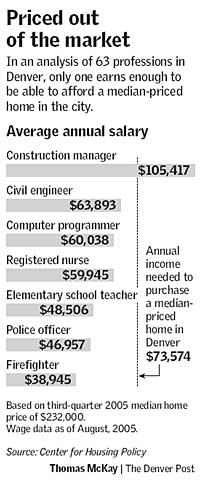
The median home price in Denver - half cost more, half less - is $232,000. To qualify for a loan to buy that home, a potential buyer would need to earn at least $73,574 a year, according to the Center for Housing Policy.

A Weld County police officer earning $38,979 a year can afford a $135,000 house - based on mortgage guidelines that limit housing payments to 30 percent of income. The median cost of a home in the area is $185,168, however.

A Mesa County cop can afford $137,000, yet the median home price there is $151,344.

Read the full article in the Denver Post . . .

Thursday, March 9, 2006

Gas Industry Fuels County Coffers

For likely the first time ever, tax revenues from Garfield County's booming natural gas industry made up the bulk of the county's assessed value -- more than monster second-homes, hotels, resorts, and shopping areas combined.Natural gas values made up 55 percent of the county's assessed value in 2005, up from 45 percent the previous year. The increase has brought $16 million more in revenues to county coffers and taxing districts, from $70.7 million in 2004 to $86.7 million last year, a 23 percent increase. Garfield County own revenues increased $7.1 million to $24.2 million.

Residential properties made up just 19 percent of the county's assessed value last year, down from 25 percent in 2004. Commercial properties contributed less, too, from 16 percent in 2004 to 14 percent in 2005.

Read the full article in the Mtn. Business Journal