EnCana USA has won Garfield County approval to operate up to 31 temporary facilities housing nearly 750 natural gas development workers north of Parachute.
Each of the facilities, known informally as man camps, is allowed to hold up to 24 employees and contractors. None would be operated more than one year under the county permits.
Energy companies have used temporary housing facilities under the permission of the Colorado Oil and Gas Conservation Commission, but the county learned it had authority to regulate them and instituted its permitting process last November.
Parachute Mayor Roy McClung wrote to the county that while the onsite housing will help, the town still will see traffic impacts related to EnCana's drilling plans and is worried about overloaded intersections and the lack of funding to improve them.
He suggested in the letter that the county needs to be collecting impact fees from such developments to meet highway improvement needs.
Read Dennis Webb's full article . . .

Showing posts with label Housing. Show all posts
Showing posts with label Housing. Show all posts
Thursday, July 5, 2007

Friday, April 27, 2007
Glenwood Meadows affordable housing project fizzles
Despite two and a half years of planning and support from both the City of Glenwood Springs (deferred payment of $800,000 in development fees and construction of a park on the property) and Garfield County ($1.5 million in cash), a proposed 120-unit lower-income apartment project at Glenwood Meadows is dead.
The Colorado Housing and Finance Authority turned down a request from the Aspen-based Dunrene Group for $8.9 million in tax credits.
Arny Porath, the project’s developer, is hoping to build the project on another property, but finding that property could be a challenge.
CHFA previously had awarded the project the tax credits, but developers couldn’t meet the deadline to use them. They reapplied once they had put together a package that included the city and county assistance, but CHFA worried about continuing increases in construction expenses for the project.
While the developers can reapply for the tax credits later this year, but Dunrene Group's Robert MacGregor said he couldn't afford to losing another construction season and the prospoect of even higher construction costs.
Macgregor said he expects he will look to partner with a developer of more traditional middle-class housing on his property. Such a project would have to comply with Glenwood Springs requirement to provide 15 percent affordable housing, or contribute an equivalent amount to an affordable housing fund.
Read Dennis Webb's full article . . .
The Colorado Housing and Finance Authority turned down a request from the Aspen-based Dunrene Group for $8.9 million in tax credits.
Arny Porath, the project’s developer, is hoping to build the project on another property, but finding that property could be a challenge.
CHFA previously had awarded the project the tax credits, but developers couldn’t meet the deadline to use them. They reapplied once they had put together a package that included the city and county assistance, but CHFA worried about continuing increases in construction expenses for the project.
While the developers can reapply for the tax credits later this year, but Dunrene Group's Robert MacGregor said he couldn't afford to losing another construction season and the prospoect of even higher construction costs.
Macgregor said he expects he will look to partner with a developer of more traditional middle-class housing on his property. Such a project would have to comply with Glenwood Springs requirement to provide 15 percent affordable housing, or contribute an equivalent amount to an affordable housing fund.
Read Dennis Webb's full article . . .
Tuesday, April 10, 2007
Green buildings get preference in Saanich
Saanich, BC wants residential builders to build "green" by cutting "red" tape. It is giving priority to applications for housing projects using energy-efficient components and provide those builders rebates of up to 30 per cent on building-permit fees.
Read the full article . . .
Lack of affordable housing on both coasts
 Seattle and Boston are on opposite coasts but they share a common concern -- a lack of affordable housing. And not just a lack of affordable housing for lower income residents. Each city is facing a severe affordable housing shortage for low and middle income residents.
As the Post-Intelligencer reports, the median prices for a house in Seattle was about $450,000 and $290,000 for a condo, while the typical single person in Seattle earned enough to buy a home for just under $200,000. Many median-income workers choose to buy and commute rather than rent and hour commutes each are becoming more and more common and today, only 49 percent of Seattle's workforce lives in the city.
Boston is looking for ways to build affordable housing lost to the free market. Robert Kuttner writes in the Boston Globe, that the $60 billion of federal money spent between 1965 and 1990 to subsidize private developers to build affordable housing in Boston is now being squandered since there were no requirements to keep the units affordable in perpetuity. Once the initial federal loan is paid off, developers/owners are free to sell or rent the housing to the highest bidder. Consequently, the affordable housing built with at taxpayer support is now becoming a windfall profit for the developer/owner.
Thursday, March 15, 2007
Aspen mayoral race heats up
Although there is still time for other candidates to enter the race, the current candidates for Mayor of Aspen began their first debate in the media by sparring over the city's affordable housing program. Candidate, and former City Council member, Tim Semaru recently suggested increasing the appreciation cap to 5% annually on deed restricted units . The current cap is 3 percent or the national rate of inflation, whichever is lower.
Candidates Mick Ireland and Torre both discarded the suggestion. Ireland, who lives in deed-restricted affordable housing, said Semaru's suggestion would be a negation of the deal between the city and citizens more than 20 years ago. Torre commented that he didn't think the change was neccessary since people "who are in employee housing aren't using it to make money, just to get in the door."
Tom McCabe, director of the Aspen/Pitkin County Housing Authority, said he is worried that the Semaru's plan would hurt local government's ability to prevent the conversion of some 224 housing units into free-market condominiums in the future.
Learn more about Aspen's Affordable Housing Program . . .
Candidates Mick Ireland and Torre both discarded the suggestion. Ireland, who lives in deed-restricted affordable housing, said Semaru's suggestion would be a negation of the deal between the city and citizens more than 20 years ago. Torre commented that he didn't think the change was neccessary since people "who are in employee housing aren't using it to make money, just to get in the door."
Tom McCabe, director of the Aspen/Pitkin County Housing Authority, said he is worried that the Semaru's plan would hurt local government's ability to prevent the conversion of some 224 housing units into free-market condominiums in the future.
Learn more about Aspen's Affordable Housing Program . . .
Friday, February 23, 2007
Housing prices continue upward
The national housing market may be stagnant, but housing in the mountains continues on an upward trajectory. According to a recent article in the Aspen Times, the average price for a three-bedroom home jumped, often substainally, throughout the region in 2006.
Basalt: $694,880 (up 21%)
Carbondale: $476,000 (up 4%)
Glenwood Springs: $383,932 (up 21%)
Rifle: $231,851 (up 14%)
The median income for a four person household in Garfield County was $62,300 in 2005.
Basalt: $694,880 (up 21%)
Carbondale: $476,000 (up 4%)
Glenwood Springs: $383,932 (up 21%)
Rifle: $231,851 (up 14%)
The median income for a four person household in Garfield County was $62,300 in 2005.
Thursday, January 25, 2007
Garfield County joins billionaires club
Garfield County joined the billionaires club in 2006 as the volume of all real estate sales in the county topped $1 billion for the first time last year. The $1.04 billion in total sales for 2006 was an increase of 22 percent over the 2005 mark and growth of 137 percent from 2003.
The oil and gas boom in western Garfield County is driving the real estate development boom in western Garfield County. An estimated $75 million of the $1 billion in commercial and residential sales in Garfield County occurred in Rifle last year.
Meanwhile, Pitkin County has remained above the $1 billion level in annual sales volume for each of the last four years. Sales volume topped $2 billion in 2005 and soared to $2.64 billion last year.
Read Scott Condon's full article ...
The oil and gas boom in western Garfield County is driving the real estate development boom in western Garfield County. An estimated $75 million of the $1 billion in commercial and residential sales in Garfield County occurred in Rifle last year.
Meanwhile, Pitkin County has remained above the $1 billion level in annual sales volume for each of the last four years. Sales volume topped $2 billion in 2005 and soared to $2.64 billion last year.
Read Scott Condon's full article ...
Tuesday, December 12, 2006
No Parking: Condos Leave Out Cars
A recent NY Times article highlights examples of condos being built without associated parking spaces. Although this practice goes against the codes in many communities, planners are realizing that "free parking" might be a reason why housing has become so unaffordable to middle-income families.
The article quotes Donald Shoup, a professor of urban planning at the University of California at Los Angeles and the author of The High Cost of Free Parking, "In the United States, housing is expensive and parking is cheap. We’ve got it the wrong way around.”
Read the full aricle in the New York Times . . .
The article quotes Donald Shoup, a professor of urban planning at the University of California at Los Angeles and the author of The High Cost of Free Parking, "In the United States, housing is expensive and parking is cheap. We’ve got it the wrong way around.”
Although condominiums without parking are common in Manhattan and the downtowns of a few other East Coast cities, they are the exception to the rule in most of the country. In fact, almost all local governments require developers to provide a minimum number of parking spaces for each unit — and to fold the cost of the space into the housing price.
The exact regulations, which are intended to prevent clogged streets and provide sufficient parking, vary by city. Houston’s code requires a minimum of 1.33 parking spaces for a one-bedroom and 2 spaces for a three-bedroom. Downtown Los Angeles mandates 2.25 parking spaces per unit, regardless of size.
Today, city planners around the country are trying to change or eliminate these standards, opting to promote mass transit and find a way to lower housing costs.
Read the full aricle in the New York Times . . .
Wednesday, November 8, 2006
Summit County votes for affordable housing
 This summer, when Summit Housing Authority Board decided to put a funding question on the ballot, the polls did not look particularly good.
The proposed combination of a new sales tax and impact fees - fees assessed on new construction based on square footage - was the most popular scenario among respondents, but garnered support from only 47 percent of those surveyed.
The sales tax increase of 12.5 cents per hundred dollars will raise about $1.4 million. The graduated impact fees start at zero for smaller units and go up to $2 per square foot for units bigger than 5,000 square-feet, generating an expected $2 million the first year.
With projected funding of up to $3.4 million the first year, the new Multi-jurisdictional Housing Authority (MJHA) hopes to gear and build up to 50 units of affordable housing per year.
Read the full article by Bob Berwyn . . .
Wednesday, September 6, 2006
Multi-family affordable development opens in Steamboat
Fox Creek is a new development in Steamboat Springs containing 30 deed-restricted, affordable housing condominiums, designed for families and homeowners with low to moderate incomes.
The ribbon-cutting marked the culmination of three years of work by the Yampa Valley Housing Authority, which planned, managed and spearheaded funding for the $6 million development.
Most Fox Creek residents will close on the purchase of their new homes later this month. Most of the units at Fox Creek have two bedrooms and two bathrooms. With grant assistance, all homebuyers will pay less than $200,000.
Read the full article in the Steamboat Pilot . . .
The ribbon-cutting marked the culmination of three years of work by the Yampa Valley Housing Authority, which planned, managed and spearheaded funding for the $6 million development.
Most Fox Creek residents will close on the purchase of their new homes later this month. Most of the units at Fox Creek have two bedrooms and two bathrooms. With grant assistance, all homebuyers will pay less than $200,000.
Read the full article in the Steamboat Pilot . . .
Tuesday, September 5, 2006
From 'Edge of Hell' to Luxury homes in El Jebel
The village that began as affordable housing for workers at Ruedi Reservoir and the Fryingpan-Arkansas water diversion project is now the site of Shadowrock, a high-end townhouse project where prices will start at almost $600,000.
A powerhouse real estate development and acquisition firm from Dallas is building the first phase of the 100-townhouse project.
In the past, some observers snidely referred to El Jebel as "edge of hell." Now it is home to several top restaurants, a collection of shops and service providers, a bowling alley and theater. Willits developer Michael Lipkin is completing the first building in what will be a 10-block town center with numerous more shops and restaurants.
Read the full article in the Aspen Times . . .
A powerhouse real estate development and acquisition firm from Dallas is building the first phase of the 100-townhouse project.
In the past, some observers snidely referred to El Jebel as "edge of hell." Now it is home to several top restaurants, a collection of shops and service providers, a bowling alley and theater. Willits developer Michael Lipkin is completing the first building in what will be a 10-block town center with numerous more shops and restaurants.
Read the full article in the Aspen Times . . .
Thursday, August 31, 2006
New Castle is booming
Another small town on the Western Slope is booming.
The town of New Castle, 10 miles west of Glenwood Springs along the I-70 corridor, is growing and it's expected to more than double in size when all of the current platted land is developed. The town currently has around 1,300 residential units within town limits. With four subdivisions now in development, that number will increase to approximately 3,740 if it reaches full build-out.
The subdivisions include:
According to Steve Rippy, former town administrator and current community development consultant for New Castle, the town is experiencing little strain on the water and waste water facilities because the town began expanding the facilities to accommodate the anticipated growth in 1999 and 2001.
The $1.2 million final phase is scheduled to begin around mid-September. This upgrade is an efficiency upgrade to the clarification system that returns solids back into the aerobic system for further breakdown. The addition of an automated grit removal system will increase the efficiency of the filtration system by mechanically removing solids before they reach the plant.
Expansions of the water plant started in 2001 with the addition of three water filtration units. Another filtration unit will be added to the plant this winter - the third upgrade in a six-year plan is scheduled to conclude in 2007.
Read the full article in the Post Independent . . .
The town of New Castle, 10 miles west of Glenwood Springs along the I-70 corridor, is growing and it's expected to more than double in size when all of the current platted land is developed. The town currently has around 1,300 residential units within town limits. With four subdivisions now in development, that number will increase to approximately 3,740 if it reaches full build-out.
The subdivisions include:
- Castle Valley - 1,400 total units, 620 built or currently under construction.
- Lakota Canyon - 827 total units, approximately 90 built or currently under construction, half of the land is already platted.
- River Park - Approximately 150 units when complete
- Castle Ridge - 67 total units, 12 currently built or under construction.
According to Steve Rippy, former town administrator and current community development consultant for New Castle, the town is experiencing little strain on the water and waste water facilities because the town began expanding the facilities to accommodate the anticipated growth in 1999 and 2001.
The $1.2 million final phase is scheduled to begin around mid-September. This upgrade is an efficiency upgrade to the clarification system that returns solids back into the aerobic system for further breakdown. The addition of an automated grit removal system will increase the efficiency of the filtration system by mechanically removing solids before they reach the plant.
Expansions of the water plant started in 2001 with the addition of three water filtration units. Another filtration unit will be added to the plant this winter - the third upgrade in a six-year plan is scheduled to conclude in 2007.
Read the full article in the Post Independent . . .
Tuesday, August 22, 2006
Local governments join together to build affordable housing
In a unique partnership, Mountain Village, Telluride and San Miguel County have joined together to develop and construct an affordable housing project.
Called the Sunnyside Affordable Housing project, it is planned for immediately west of Eider Creek, and will include some 48 units. The parcel is owned and will be spearheaded by the county, but Mountain Village and Telluride are chipping in on access, water and sewer.
Telluride Mayor John Pryor said the fact that all three governments have joined together to work to mend this urgent regional issue is remarkable.
“The Town of Telluride is very excited to be at the table and working hard at providing more affordable housing with this Sunnyside project with our two other local governments,” Pryor said.
Although the governments have signed on and much groundwork has been laid by the sketch plan, the project is still in its early stages and many details remain to be hammered out.
Read the full article in the Telluride Daily Planet . . .
Called the Sunnyside Affordable Housing project, it is planned for immediately west of Eider Creek, and will include some 48 units. The parcel is owned and will be spearheaded by the county, but Mountain Village and Telluride are chipping in on access, water and sewer.
Telluride Mayor John Pryor said the fact that all three governments have joined together to work to mend this urgent regional issue is remarkable.
“The Town of Telluride is very excited to be at the table and working hard at providing more affordable housing with this Sunnyside project with our two other local governments,” Pryor said.
Although the governments have signed on and much groundwork has been laid by the sketch plan, the project is still in its early stages and many details remain to be hammered out.
Read the full article in the Telluride Daily Planet . . .
Saturday, July 8, 2006
Summit struggles to fund affordable housing efforts
The Summit Housing Authority (SHA) board of directors decided this week to pursue placing an initiative on November's ballot in order to fund a countywide multi-jurisdictional housing authority, despite less than encouraging results from a survey of county residents on a potential tax question.
The move is spurred, in part, by the expiration at the end of this year of the of the existing intergovernmental agreement between the towns, the county and the ski resorts that funds the the authority. Even without the expiration of the IGA, SHA needs more money to tackle the formidable task of finding the 3,000 additional units of affordable housing, which a recent needs assessment predicted Summit County will require by 2010.
Funding for a countywide affordable housing entity could be obtained from tax sources, if approved by voters. Possibilities for financial support for a housing agency include impact fees, sales taxes, property taxes or some combination of the three.
A recent survey asked respondents about their support for possible tax combinations that could provide the housing authority with anywhere between $1.3 million and $5 million per year. The combination of a new sales tax and impact fees - fees assessed on new construction based on square footage - was the most popular scenario among respondents, but garnered support from only 47 percent of those surveyed.
SHA last went to county voters in 2002 to request a sales tax which would have raised about $400,000 a year for affordable housing, but the measure was defeated bt a seven-to-six margin.
Read the full article in the Summit Daily . . .
placing an initiative on November's ballot in order to fund a countywide multi-jurisdictional housing authority, despite less than encouraging results from a survey of county residents on a potential tax question.The move is spurred, in part, by the expiration at the end of this year of the of the existing intergovernmental agreement between the towns, the county and the ski resorts that funds the the authority. Even without the expiration of the IGA, SHA needs more money to tackle the formidable task of finding the 3,000 additional units of affordable housing, which a recent needs assessment predicted Summit County will require by 2010.
Funding for a countywide affordable housing entity could be obtained from tax sources, if approved by voters. Possibilities for financial support for a housing agency include impact fees, sales taxes, property taxes or some combination of the three.
A recent survey asked respondents about their support for possible tax combinations that could provide the housing authority with anywhere between $1.3 million and $5 million per year. The combination of a new sales tax and impact fees - fees assessed on new construction based on square footage - was the most popular scenario among respondents, but garnered support from only 47 percent of those surveyed.
SHA last went to county voters in 2002 to request a sales tax which would have raised about $400,000 a year for affordable housing, but the measure was defeated bt a seven-to-six margin.
Read the full article in the Summit Daily . . .
Thursday, July 6, 2006
Local government as housing developer
The lack of affordable housing in mountain communities has some local governments taking a more active role in the development process - add another to the list:
The Town of Mountain Village, near Telluride, is in the process of purchasing four lots in Mountain Village's Timberview subdivision and just added property in Ilium Valley. The property in Ilium Valley is already zoned for development and can shoulder 13 affordable housing units.
“We're not land-banking it waiting for some sort of strategy to emerge,” Mayor Davis Fansler said, alluding to the Village's failed attempt to purchase some 100-plus acres in the San Miguel River Canyon earlier this winter. “we're trying to chip away at the issue."
The village will pay $65,000 per unit, or $845,000 in total for the land, which is expected to close in late July.
The funds for both purchases will come from the Mountain Village Housing Authority, though the Mountain Village Homeowner's Association $500,000 as a donation toward affordable housing.
The Timberview property in the Village will cost the town $510,000.
Read the full article in the Telluride Daily Planet . . .
The Town of Mountain Village, near Telluride, is in the process of purchasing four lots in Mountain Village's Timberview subdivision and just added property in Ilium Valley. The property in Ilium Valley is already zoned for development and can shoulder 13 affordable housing units.
“We're not land-banking it waiting for some sort of strategy to emerge,” Mayor Davis Fansler said, alluding to the Village's failed attempt to purchase some 100-plus acres in the San Miguel River Canyon earlier this winter. “we're trying to chip away at the issue."
The village will pay $65,000 per unit, or $845,000 in total for the land, which is expected to close in late July.
The funds for both purchases will come from the Mountain Village Housing Authority, though the Mountain Village Homeowner's Association $500,000 as a donation toward affordable housing.
The Timberview property in the Village will cost the town $510,000.
Read the full article in the Telluride Daily Planet . . .
Monday, June 19, 2006
Basalt becoming millionaires' club
The red-hot real estate market has sent the median price of single family homes for sale in and around Basalt above the $1 million barrier.
The median price of the 27 single-family homes that sold in and around Basalt through mid-May was $695,000. The median price of 19 homes currently under contract in that same area is $899,000. The median asking price for the 19 homes currently listed for sale is $1,195,000.
While the appreciation is welcome news for sellers and most people who already own property, it also pushes the Basalt area out of the realm of affordability for workers.
At a recent public meeting, Garfield County Commissioner Tresi Houpt had this observation: "Aspen has the billionaires, Basalt has the millionaires, and we've got the working stiffs" in Garfield County.
Read the full article in the Vail Daily . . .
Tuesday, May 9, 2006
Yampa Valley Housing Authority looks at funding options to meet needs
The Yampa Valley Housing Authority is looking for ways to meet the growing need for affordable housing in Routt County. YVHA currently relies on funding from Steamboat Springs and Routt County to fund projects. The Housing Authority was formed in early 2004 and is composed of a variety of community members.
According to state statute, there are three options for dedicated funding sources: a sales tax of 1 percent or less; a property tax of 5 mills or less; or an impact fee of $2 or less per square foot. An impact fee charges a dollar amount for every square foot of a new building. If the Housing Authority chooses an impact fee, it must also have a tax. All three of the options require a vote by the residents who live within the Housing Authority's boundaries.
YVHA staff and board members said it is too early to say what type of funding the board may go for. Funds that are gained from a dedicated funding source would be used for more affordable housing projects.
The median sale price of a home in Routt County -- the price that falls in the middle of prices for all home solds -- rose from about $270,000 in 2000 to $370,000 in 2004. In April, only one single-family home in Steamboat Springs area listed at less than $300K.
Read the full article in the Steamboat Pilot . . .
According to state statute, there are three options for dedicated funding sources: a sales tax of 1 percent or less; a property tax of 5 mills or less; or an impact fee of $2 or less per square foot. An impact fee charges a dollar amount for every square foot of a new building. If the Housing Authority chooses an impact fee, it must also have a tax. All three of the options require a vote by the residents who live within the Housing Authority's boundaries.
YVHA staff and board members said it is too early to say what type of funding the board may go for. Funds that are gained from a dedicated funding source would be used for more affordable housing projects.
The median sale price of a home in Routt County -- the price that falls in the middle of prices for all home solds -- rose from about $270,000 in 2000 to $370,000 in 2004. In April, only one single-family home in Steamboat Springs area listed at less than $300K.
Read the full article in the Steamboat Pilot . . .
Monday, March 27, 2006
Garfield housing becoming less and less affordable
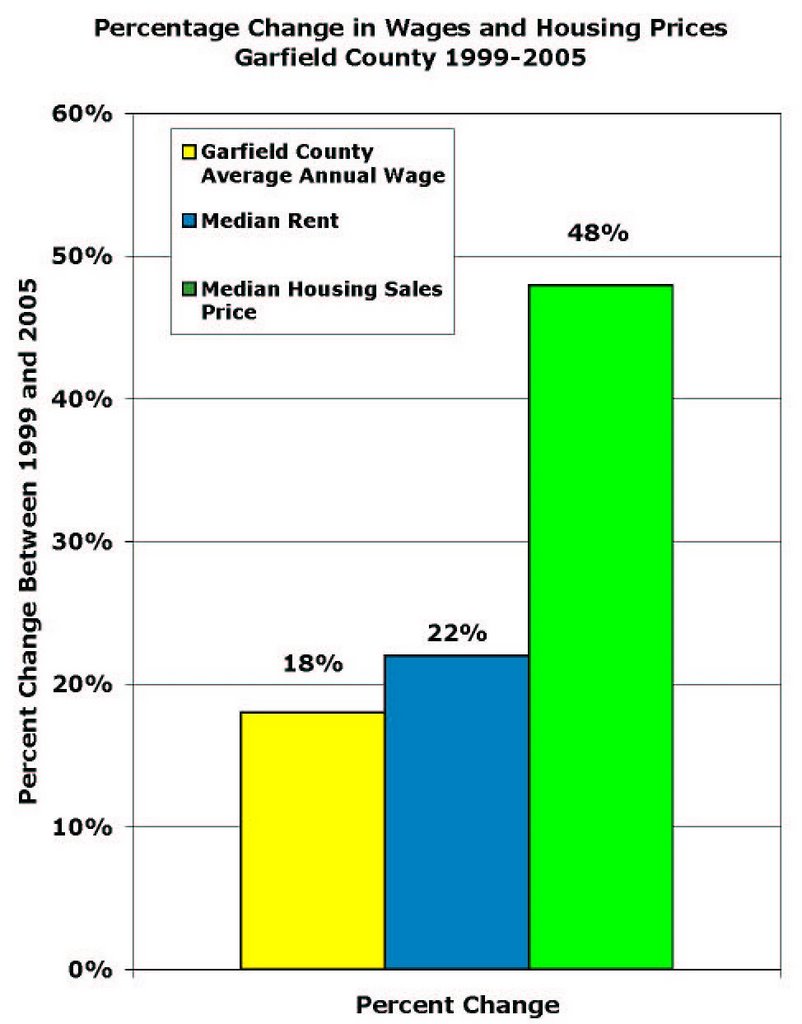 The days of Garfield County being the "affordable housing stock" for Pitkin County could be coming to a close. A recently released study by the Garfield County Building & Planning Department shows that the median income household cannot afford the median priced home in the county.
While wages have risen 18 percent between 1999 and 2005, prices for single-family homes have jumped 48 percent, putting them out of reach for many.
Out of the 809 units listed for sale in Garfield County in October 2005, 43 percent are priced at or above $500,000. Most of those homes are in Glenwood Springs and Carbondale, but every community in the county has homes for sale at that price.
Today, a family earning 120 percent of the AMI, or $68,280 annually, cannot afford the average price of a single-family home in Glenwood Springs, which in 2005 was $325,000, or Carbondale, where a single-family home averaged $395,000.
Currently, a family earning less than the area median income cannot not afford a home in New Castle or Silt.
Read the full article in the Post Independent . . .
Thursday, March 23, 2006
Owning a home becoming more elusive
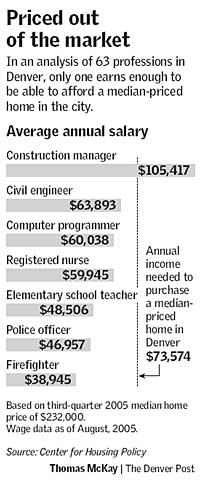 Working families with children are finding it harder than ever to own their homes, according to a study released Wednesday by the Center for Housing Policy.
The national trend is driven by a combination of factors: higher health-care bills, a rise in the number of single parents and soaring housing costs that have outpaced wage increases.
The effects are being felt in communities where teachers, police and firefighters can't afford to buy homes where they work.
The median home price in Denver - half cost more, half less - is $232,000. To qualify for a loan to buy that home, a potential buyer would need to earn at least $73,574 a year, according to the Center for Housing Policy.
A Weld County police officer earning $38,979 a year can afford a $135,000 house - based on mortgage guidelines that limit housing payments to 30 percent of income. The median cost of a home in the area is $185,168, however.
A Mesa County cop can afford $137,000, yet the median home price there is $151,344.
Read the full article in the Denver Post . . .
Wednesday, February 22, 2006
Cost of living in Aspen 300 percent higher than the national average
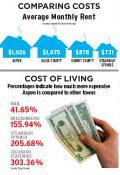 A new study, based on a data collected by the American Chamber of Commerce Researchers Association and the city of Aspen, shows that the cost of living in Aspen is more than 300 percent higher than the national average. The study takes into account prices for groceries, housing, utilities, health care, transportation and miscellaneous goods and services.
Housing was by far the greatest expense in Aspen, with costs soaring 951 percent above the national average.That figure was decreased significantly for residents of Aspen's subsidized employee housing, although their housing cost was still 23 percent above the national average and their overall cost of living 32.75 percent higher than the rest of the country.
Aspen's cost of living was about 42 percent higher than Vail's, 156 percent higher than Breckenridge's and 206 percent greater than Steamboat Springs.
As the cost of living in Aspen continues to rise, a community where a permanent, year-round workforce can afford to live becomes increasinly difficult to maintain.
"The critical element to solving the [housing] problem is recognizing the cost," said Pitkin County Commissioner Mick Ireland. "It really has to do with the outside demand for real estate, which you can't control. A larger number of baby boomers have more money and are more inclined to buy second homes, and all that demand pushes up real estate costs. So you don't fix the problem by saying, 'Let's build more housing, then the price will go down.' There are more baby boomers out there than we can feed."
Instead, Ireland points to Aspen's affordable housing program as a successful system that gives the local non-millionaires a way to buy a home.
"That has put a damper on price increase and made some opportunities for people to stay here who we would have otherwise lost," explained Ireland.
Read the full article in the Aspen Daily News
Subscribe to:
Posts (Atom)