Garfield County joined the billionaires club in 2006 as the volume of all real estate sales in the county topped $1 billion for the first time last year. The $1.04 billion in total sales for 2006 was an increase of 22 percent over the 2005 mark and growth of 137 percent from 2003.
The oil and gas boom in western Garfield County is driving the real estate development boom in western Garfield County. An estimated $75 million of the $1 billion in commercial and residential sales in Garfield County occurred in Rifle last year.
Meanwhile, Pitkin County has remained above the $1 billion level in annual sales volume for each of the last four years. Sales volume topped $2 billion in 2005 and soared to $2.64 billion last year.
Read Scott Condon's full article ...

Showing posts with label indicators. Show all posts
Showing posts with label indicators. Show all posts
Thursday, January 25, 2007

Tuesday, December 12, 2006
No Parking: Condos Leave Out Cars
A recent NY Times article highlights examples of condos being built without associated parking spaces. Although this practice goes against the codes in many communities, planners are realizing that "free parking" might be a reason why housing has become so unaffordable to middle-income families.
The article quotes Donald Shoup, a professor of urban planning at the University of California at Los Angeles and the author of The High Cost of Free Parking, "In the United States, housing is expensive and parking is cheap. We’ve got it the wrong way around.”
Read the full aricle in the New York Times . . .
The article quotes Donald Shoup, a professor of urban planning at the University of California at Los Angeles and the author of The High Cost of Free Parking, "In the United States, housing is expensive and parking is cheap. We’ve got it the wrong way around.”
Although condominiums without parking are common in Manhattan and the downtowns of a few other East Coast cities, they are the exception to the rule in most of the country. In fact, almost all local governments require developers to provide a minimum number of parking spaces for each unit — and to fold the cost of the space into the housing price.
The exact regulations, which are intended to prevent clogged streets and provide sufficient parking, vary by city. Houston’s code requires a minimum of 1.33 parking spaces for a one-bedroom and 2 spaces for a three-bedroom. Downtown Los Angeles mandates 2.25 parking spaces per unit, regardless of size.
Today, city planners around the country are trying to change or eliminate these standards, opting to promote mass transit and find a way to lower housing costs.
Read the full aricle in the New York Times . . .
Tuesday, December 5, 2006
Surprise! Health costs rise faster than pay
There doesn't seem to be any commodity that people's pay can keep up with these days. Add Health care to the list. Although the rate of increase has slip to less than double digits increases over the last few years, health costs have still almost doubled (82.2%) since since 2000. Workers wages increased a paltry 15%.
Anyway you count the numbers, the results ain't pretty for workers. Read Will Shanley's article in the Denver Post . . .
Anyway you count the numbers, the results ain't pretty for workers. Read Will Shanley's article in the Denver Post . . .
Health care costs in Colorado have jumped 82.2 percent since 2000, more than five times the earnings increase for workers.
For family health coverage, the average annual premium paid by workers and employers rose to $12,386 in 2006, up from $6,797 in 2000.
Meanwhile, worker wages statewide grew by 15 percent, or $3,947, to a median of $30,337 per year.
Those findings were reported Monday in the study "Premiums Versus Paychecks: A Growing Burden for Colorado's Workers." Families USA, a health care advocacy group based in New York, prepared the report.
Tuesday, September 5, 2006
From 'Edge of Hell' to Luxury homes in El Jebel
The village that began as affordable housing for workers at Ruedi Reservoir and the Fryingpan-Arkansas water diversion project is now the site of Shadowrock, a high-end townhouse project where prices will start at almost $600,000.
A powerhouse real estate development and acquisition firm from Dallas is building the first phase of the 100-townhouse project.
In the past, some observers snidely referred to El Jebel as "edge of hell." Now it is home to several top restaurants, a collection of shops and service providers, a bowling alley and theater. Willits developer Michael Lipkin is completing the first building in what will be a 10-block town center with numerous more shops and restaurants.
Read the full article in the Aspen Times . . .
A powerhouse real estate development and acquisition firm from Dallas is building the first phase of the 100-townhouse project.
In the past, some observers snidely referred to El Jebel as "edge of hell." Now it is home to several top restaurants, a collection of shops and service providers, a bowling alley and theater. Willits developer Michael Lipkin is completing the first building in what will be a 10-block town center with numerous more shops and restaurants.
Read the full article in the Aspen Times . . .
Thursday, August 31, 2006
Public picks up more of hospital tab
 Medicare and Medicaid programs paid for more than half of all patient days at Colorado hospitals in 2005, fresh evidence that taxpayers are increasingly picking up the tab for health care at hospitals.
Data released by the Colorado Health and Hospital Association show Medicare and Medicaid combined to pay for 52 percent of patient hospital days in Colorado - the highest percentage ever reported for the state by the association.
Medicare, a federal program that covers people over age 65, paid for 34.2 percent of patient days statewide last year. Medicaid, a program for the poor that is equally funded by the state and federal taxpayers, picked up the tab for 17.8 percent of patient days, the report showed.
The balance of patient days are paid by private insurance, individual payments and other forms of payment such as workers' compensation.
The government programs, especially Medicaid, do not fully cover the costs for hospital stays. As a result, hospitals are forced to shift the financial burden to private-paying patients and employers through higher insurance premiums, said Stuart Guterman, director of the Medicare's Future program at the Commonwealth Fund, a Washington, D.C., foundation.
There are an estimated 46 million uninsured Americans. That includes about 767,000 people in Colorado, or 17 percent of the state population, according to the U.S. Census Bureau.
Read the full article in the Denver Post . . .
New Castle is booming
Another small town on the Western Slope is booming.
The town of New Castle, 10 miles west of Glenwood Springs along the I-70 corridor, is growing and it's expected to more than double in size when all of the current platted land is developed. The town currently has around 1,300 residential units within town limits. With four subdivisions now in development, that number will increase to approximately 3,740 if it reaches full build-out.
The subdivisions include:
According to Steve Rippy, former town administrator and current community development consultant for New Castle, the town is experiencing little strain on the water and waste water facilities because the town began expanding the facilities to accommodate the anticipated growth in 1999 and 2001.
The $1.2 million final phase is scheduled to begin around mid-September. This upgrade is an efficiency upgrade to the clarification system that returns solids back into the aerobic system for further breakdown. The addition of an automated grit removal system will increase the efficiency of the filtration system by mechanically removing solids before they reach the plant.
Expansions of the water plant started in 2001 with the addition of three water filtration units. Another filtration unit will be added to the plant this winter - the third upgrade in a six-year plan is scheduled to conclude in 2007.
Read the full article in the Post Independent . . .
The town of New Castle, 10 miles west of Glenwood Springs along the I-70 corridor, is growing and it's expected to more than double in size when all of the current platted land is developed. The town currently has around 1,300 residential units within town limits. With four subdivisions now in development, that number will increase to approximately 3,740 if it reaches full build-out.
The subdivisions include:
- Castle Valley - 1,400 total units, 620 built or currently under construction.
- Lakota Canyon - 827 total units, approximately 90 built or currently under construction, half of the land is already platted.
- River Park - Approximately 150 units when complete
- Castle Ridge - 67 total units, 12 currently built or under construction.
According to Steve Rippy, former town administrator and current community development consultant for New Castle, the town is experiencing little strain on the water and waste water facilities because the town began expanding the facilities to accommodate the anticipated growth in 1999 and 2001.
The $1.2 million final phase is scheduled to begin around mid-September. This upgrade is an efficiency upgrade to the clarification system that returns solids back into the aerobic system for further breakdown. The addition of an automated grit removal system will increase the efficiency of the filtration system by mechanically removing solids before they reach the plant.
Expansions of the water plant started in 2001 with the addition of three water filtration units. Another filtration unit will be added to the plant this winter - the third upgrade in a six-year plan is scheduled to conclude in 2007.
Read the full article in the Post Independent . . .
Mining Gypsum: Developers see gold in tiny town west of Vail
Eagle County has exploded in recent years, doubling in population from 1990 to 2000, and reaching an estimated 47,530 people in 2005, according to the U.S. Census Bureau. Gypsum has mirrored that trend, growing from 1,750 residents in 1990 to more than 5,200 today - and its not finished yet.
The old mining town, 35 miles west of Vail, is home to several major new projects, including:
The town's coffers have been swelling for several years. Gypsum's real estate transfer tax grew from $704,800 in 2004 to $1.48 million last year. Sales-tax revenues grew from $1.46 million in 2004 to $2.33 million last year.
Sales-tax revenue from the new projects will help Gypsum pay off its new $12.2 million recreation center - scheduled to open in November - in less than 10 years.
Read the full article in the Denver Post . . .
The old mining town, 35 miles west of Vail, is home to several major new projects, including:
- The Brightwater Club, which soon will hold 535 single-family homes, a Robert Trent Jones Jr. golf course, 27 acres of lakes and a village that will offer restaurants, a gourmet market, and a fitness center and spa. With homesites starting at $300,000, more than 120 lots have sold to date and 45 more are under contract, totaling more than $80 million in sales. The average Brightwater home ranges from $1.1 million to $2.1 million.
- A 155,000-square-foot Costco store, scheduled to open Oct. 20, expects to draw shoppers from as far as Vail, Aspen and Steamboat Springs. The store will employ 160 people and is expected to generate more than $3 million in annual sales-tax revenues.
- The Tower Center, which includes 475,000 square feet of retail, including at least two big-box stores, 330 housing units and at least one hotel. Tower Center is expected to generate at least $5 million in annual sales-tax revenue for Gypsum.
The town's coffers have been swelling for several years. Gypsum's real estate transfer tax grew from $704,800 in 2004 to $1.48 million last year. Sales-tax revenues grew from $1.46 million in 2004 to $2.33 million last year.
Sales-tax revenue from the new projects will help Gypsum pay off its new $12.2 million recreation center - scheduled to open in November - in less than 10 years.
Read the full article in the Denver Post . . .
Thursday, August 3, 2006
The first published map of global happiness

Adrian White, Analytic Social Psychologist, at the University of Leicester has mapped the relateive happiness of all the countries in the world. An interacted map allows viewers to check out their own country "happiness" rating compared to other countries around the world.
Scandinavia has 4 counties in the top 20 (Denmark - 1, Finland - 6, Sweden - 7 and Norway - 19). Canada comes in with an impress 10th place while the US ranks 23 out of 178 counties.
The map is based on an analysis of the results from over 100 studies. It uses data published by by UNESCO, the CIA, the New Economics Foundation, the WHO, the Veenhoven Database, the Latinbarometer, the Afrobarometer, and the UNHDR.
Tuesday, August 1, 2006
Construction dependence a trend in many Mountain counties

Larry Swanson and the folks at the Center for the Rocky Mountain West have put together a interesting chart of construction activity by county. The map above shows areas of the U.S. with relatively high concentrations of construction activity in relation to area personal income. Dark red areas have construction labor earnings of $1.6 million and more for every $20 million in personal income - “very high” concentrations. Medium red areas have construction labor earnings of $1.3 to $1.6 million per $20 million in income (“high” dependencies) - note the group of dark red counties in western Colorado.
See all the associated charts at the Center for the Rocky Mountain West . . .
Monday, June 19, 2006
Basalt becoming millionaires' club
The red-hot real estate market has sent the median price of single family homes for sale in and around Basalt above the $1 million barrier.
The median price of the 27 single-family homes that sold in and around Basalt through mid-May was $695,000. The median price of 19 homes currently under contract in that same area is $899,000. The median asking price for the 19 homes currently listed for sale is $1,195,000.
While the appreciation is welcome news for sellers and most people who already own property, it also pushes the Basalt area out of the realm of affordability for workers.
At a recent public meeting, Garfield County Commissioner Tresi Houpt had this observation: "Aspen has the billionaires, Basalt has the millionaires, and we've got the working stiffs" in Garfield County.
Read the full article in the Vail Daily . . .
Thursday, June 8, 2006
Oh, Canada! You're healthier too!
 First is was the Brits, now its those people with the funny accents up in the Great White North that are healthier than we Americans.
 The way things are going, I've put money on the table that Cuba will be the next comparison and they will also be healthier that we are (would that be three strikes against the U.S. health care system?)
Cambridge Health Alliance (CHA) physicians, who teach at Harvard Medical School (HMS), authored a study in the July, 2006 issue of the American Journal of Public Health. Their news release states, "The study finds that U.S. residents are less healthy than Canadians, and despite spending nearly twice as much per capita for health care, U.S. residents have more problems getting care and experience more unmet health needs."
The authors found that U.S. residents were less healthy than Canadians.Canadians had better access to most types of medical care (with the single exception of pap smears). Race and income disparities, although present in both countries, were larger in the U.S. Non-whites were more likely than whites to have an unmet health need in the U.S.
In the U.S., cost was the largest barrier to care. More than seven times as many U.S. residents reported going without needed care due to cost as Canadians (7.0% of U.S. respondents vs. 0.8% of Canadians). Uninsured U.S. residents were particularly vulnerable; 30.4% reported having an unmet health need due to cost.
A copy of the study is available at: http://www.pnhp.org/canadastudy/
Money can't but U.S. health
 Hot off the presses is a study in the Journal of the American Medical Association, which compares the health of residents of the United States and the United Kingdom.
One of the key findings in the comparison is the differences between the two countries. The United States spends $5274 per person, per year, on health care and the United Kingdom spends $2164
The study made sure to have 'apple to apple' comparisons given the different demographics in the two counties, so the comparison is between 45-55 year old non-Hispanic white men and women.
The findings are brutal. By basically every standard, Americans are sicker than the Brits. Diabetes, for instance is roughly double in the US than it is in the UK. The rates of other common ailments - hypertension, heart disease, heart attacks, stroke, lung disease and cancer - are also all higher in the United States. And oftern a lot higher, despite the fact that the Brits smoke about the same amount and drink twice as much as Americans. So much for the best health system money can buy.
See the full article in the JAMA . . .
Garco study finds housing values only temporarily reduced from gas drilling
Ford Frick of BBC Research in Denver recently presented the results of a land values study commissioned by Garfield County. The study looked at the factors that drive land values and the the impacts of “rural industrialization” including gas well drilling and gravel pit operations in the county.
Frick and his team analyzed 7,600 property transactions from 1987 to 2004 as well as drilling data. There are 5,010 well drilling permits currently held in the county and 2,675 operating gas wells.
The gas industry ultimatley contributes to housing appreciation. The value lost during initial drilling activity is more than recaptured a few years later by the increasing demand for housing so don't sell your property at the first site of a drilling rig!
Read the full article in the Post Independent . . .
Thursday, April 27, 2006

Monday, March 27, 2006
Garfield housing becoming less and less affordable
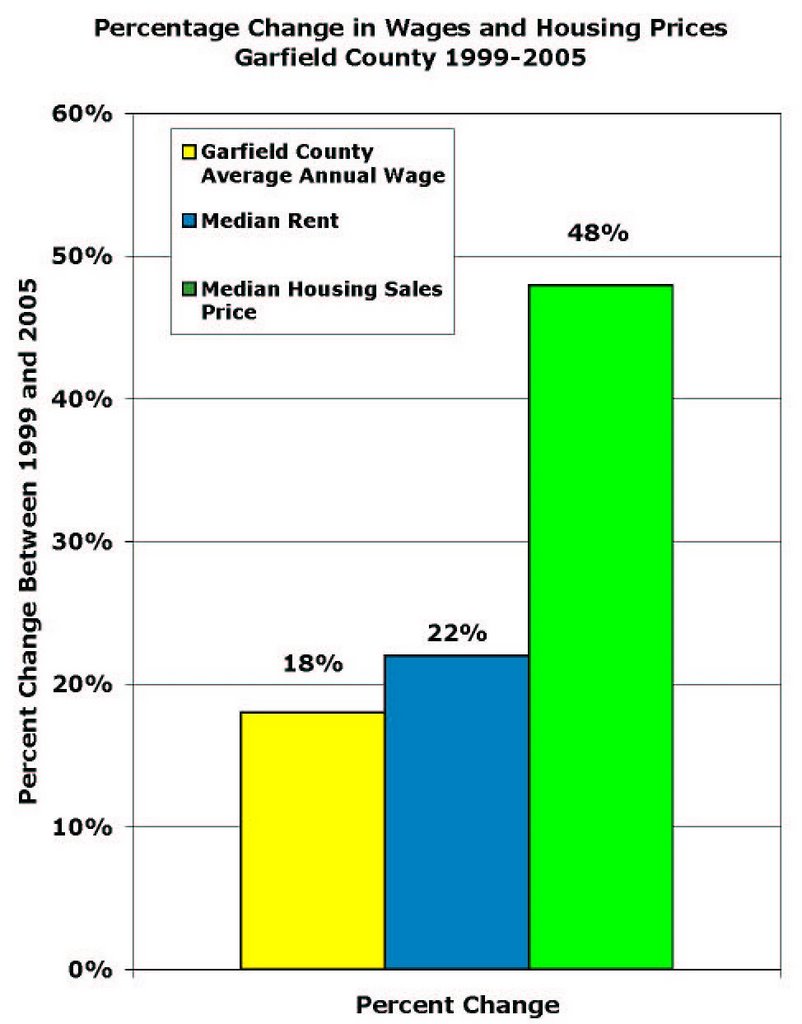 The days of Garfield County being the "affordable housing stock" for Pitkin County could be coming to a close. A recently released study by the Garfield County Building & Planning Department shows that the median income household cannot afford the median priced home in the county.
While wages have risen 18 percent between 1999 and 2005, prices for single-family homes have jumped 48 percent, putting them out of reach for many.
Out of the 809 units listed for sale in Garfield County in October 2005, 43 percent are priced at or above $500,000. Most of those homes are in Glenwood Springs and Carbondale, but every community in the county has homes for sale at that price.
Today, a family earning 120 percent of the AMI, or $68,280 annually, cannot afford the average price of a single-family home in Glenwood Springs, which in 2005 was $325,000, or Carbondale, where a single-family home averaged $395,000.
Currently, a family earning less than the area median income cannot not afford a home in New Castle or Silt.
Read the full article in the Post Independent . . .
Thursday, March 23, 2006
Owning a home becoming more elusive
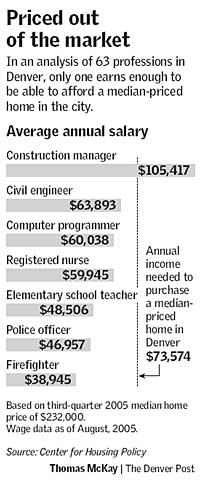 Working families with children are finding it harder than ever to own their homes, according to a study released Wednesday by the Center for Housing Policy.
The national trend is driven by a combination of factors: higher health-care bills, a rise in the number of single parents and soaring housing costs that have outpaced wage increases.
The effects are being felt in communities where teachers, police and firefighters can't afford to buy homes where they work.
The median home price in Denver - half cost more, half less - is $232,000. To qualify for a loan to buy that home, a potential buyer would need to earn at least $73,574 a year, according to the Center for Housing Policy.
A Weld County police officer earning $38,979 a year can afford a $135,000 house - based on mortgage guidelines that limit housing payments to 30 percent of income. The median cost of a home in the area is $185,168, however.
A Mesa County cop can afford $137,000, yet the median home price there is $151,344.
Read the full article in the Denver Post . . .
Wednesday, February 22, 2006
Cost of living in Aspen 300 percent higher than the national average
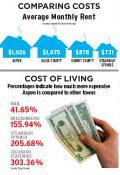 A new study, based on a data collected by the American Chamber of Commerce Researchers Association and the city of Aspen, shows that the cost of living in Aspen is more than 300 percent higher than the national average. The study takes into account prices for groceries, housing, utilities, health care, transportation and miscellaneous goods and services.
Housing was by far the greatest expense in Aspen, with costs soaring 951 percent above the national average.That figure was decreased significantly for residents of Aspen's subsidized employee housing, although their housing cost was still 23 percent above the national average and their overall cost of living 32.75 percent higher than the rest of the country.
Aspen's cost of living was about 42 percent higher than Vail's, 156 percent higher than Breckenridge's and 206 percent greater than Steamboat Springs.
As the cost of living in Aspen continues to rise, a community where a permanent, year-round workforce can afford to live becomes increasinly difficult to maintain.
"The critical element to solving the [housing] problem is recognizing the cost," said Pitkin County Commissioner Mick Ireland. "It really has to do with the outside demand for real estate, which you can't control. A larger number of baby boomers have more money and are more inclined to buy second homes, and all that demand pushes up real estate costs. So you don't fix the problem by saying, 'Let's build more housing, then the price will go down.' There are more baby boomers out there than we can feed."
Instead, Ireland points to Aspen's affordable housing program as a successful system that gives the local non-millionaires a way to buy a home.
"That has put a damper on price increase and made some opportunities for people to stay here who we would have otherwise lost," explained Ireland.
Read the full article in the Aspen Daily News
Friday, February 17, 2006
Garfield County a seller's market
 Many locals know the challenges of finding an affordable home in the Roaring Fork Valley. Now it looks like the traditional stock of affordable housing in the Colorado Valley is in short supply as well. Houses less than $200,000 are sparse at best in Rifle, Parachute and Battlement Mesa, and it's rare for those homes to be on the market more than a week.
Garfield County is close to completing a housing needs assessment that will offer more details on the housing market in the county and examine options for fostering affordable housing.
Read the full article by Bobby Magill
in the Post Independent [January 19, 2006]
Thursday, February 9, 2006
Land rush for affordable lots in Aspen
The last official land rush in the U.S. took place in Oklahoma in 1893, but the tradition lives, albeit in a more organized fashion, in some western communities.
175 people recently submitted applications to be one of seven lot owners in Aspen-Pitkin County Housing Authority's upcoming lottery. Five resident-occupied lots are priced at $150,000 and two are are priced at $119,400. Lot buyers can begin construction in July. Houses may be up to 2,200 square feet, plus a 500-square-foot garage. Construction costs for each of the five resident-occupied lots cannot exceed $640,000, and costs for the Category 6 lots are capped at $428,100.
The 2003 median sales price for home in aspen in 2003 was $3.18 million.
Read the full article in the Aspen Times
175 people recently submitted applications to be one of seven lot owners in Aspen-Pitkin County Housing Authority's upcoming lottery. Five resident-occupied lots are priced at $150,000 and two are are priced at $119,400. Lot buyers can begin construction in July. Houses may be up to 2,200 square feet, plus a 500-square-foot garage. Construction costs for each of the five resident-occupied lots cannot exceed $640,000, and costs for the Category 6 lots are capped at $428,100.
The 2003 median sales price for home in aspen in 2003 was $3.18 million.
Read the full article in the Aspen Times
Friday, January 20, 2006
Denver schools resegregate
 Denver schools have resegregated sharply since the end in 1995 of court-ordered busing to integrate students, according to study by The Civil Rights Project at Harvard University.
Denver Public Schools' student population is 57 percent Latino, 20 percent white and 19 percent black, says the study, commissioned by the Piton Foundation in Denver. But individual schools don't hold to those demographics.
The average Latino student attends a school that is 71 percent Latino. And in a district that is one-fifth white, more than one-third of white students attend schools where they are in the majority.
In 1995, 14 percent of white students attended schools where they were in the majority. Within two years, the number doubled - 31 percent of white students were attending schools where white students were the majority.
In 1973, Denver became the first northern city ordered by the U.S. Supreme Court to desegregate after a lawsuit alleged that schools in the Park Hill neighborhood were intentionally segregated to separate white students from minorities.
The challenge is to draw middle-class families into the public school system," said Alan Gottlieb, education program officer for the Piton Foundation, a private foundation dedicated to improving education in Denver. Several schools in the district have high percentages of students on free and reduced-price lunch programs and are heavily minority, yet the surrounding neighborhoods are "getting more gentrified all the time," he said.
Read the full article . . .
Subscribe to:
Posts (Atom)