- The U.S. Census Bureau recently reported that number of Colorado residents without health insurance edged up to 767,000 people last year, or 17.1 percent of the state population - higher than the 15.7%national average.
- Colorado has 11 lobbyists for every state legislator according to a report released by the Center for Public Integrity. With 1,054 lobbyists for the 100 legislators put Colorado in fourth place (and more than twice the national average) for the number of lobbyists per legislator. Only New York, Florida, and Illinois had higher ratios.

Wednesday, August 31, 2005
More interesting numbers
Numbers don't always tell the whole story, but recently reported numbers on the uninsured and the number of lobbyists per legislator in Colorado are certainly interesting:

Tuesday, August 30, 2005
Housing 101
According to a recently released study by the Center for Housing Policy, the median price of a home in the U.S. increased from $186,000 to $225,000, or 20 percent. Meanwhile, wages for key community workers (elementary school teachers, police officers, nurses, retail salespersons and janitors) in the majority of cities nationwide remained flat.
The Center has set up an on-line seachable database of housing and wage info for metropolitan areas, so only Front Range communities are included from Colorado. For folks in Western Slope communities, the information is interesting nontheless.
Turns out that Pueblo is the only metro area on the Front Range where elementary school teachers and police offiers make enough (~$45,000) to afford the median priced home ($116,00). In Colorado Springs, Ft. Collins, Denver, and Boulder. Elementary teachers and police officers need to make $13,000 more in Colorado Springs and $44,000 more in Boulder to afford the median priced homes in those communities ($180,00 and $285,000 respectively). The situation is probably more dire in resort communities where median housing prices are in the $300K - $500K range.
There has been a lot of concern and frustration with the quality of education in the state. Seems that the problem may be more than what is happening in the schools.
The Center has set up an on-line seachable database of housing and wage info for metropolitan areas, so only Front Range communities are included from Colorado. For folks in Western Slope communities, the information is interesting nontheless.
Turns out that Pueblo is the only metro area on the Front Range where elementary school teachers and police offiers make enough (~$45,000) to afford the median priced home ($116,00). In Colorado Springs, Ft. Collins, Denver, and Boulder. Elementary teachers and police officers need to make $13,000 more in Colorado Springs and $44,000 more in Boulder to afford the median priced homes in those communities ($180,00 and $285,000 respectively). The situation is probably more dire in resort communities where median housing prices are in the $300K - $500K range.
There has been a lot of concern and frustration with the quality of education in the state. Seems that the problem may be more than what is happening in the schools.
Thursday, August 11, 2005
When does the minority become the majority?
Recent census numbers show that minorities make up the majority of the population in Texas, Hawaii, New Mexico, and California. Is it an oxymoron to call have a minority majority?
Read more ...
Read more ...
Wednesday, August 3, 2005
Is Western growth on a collision course with itself?
The Intermountain West is a hot commodity these days with projections for more people, more jobs, and more oil and gas development.
Much of the population influx throughout the Colorado resort regions will be driven not by tourism but by the pure nature of the area, according to speakers at a July conference in Keystone titled, "Visions, Vistas and Viewpoints: Imagining Our Mountain Communities in 2030."
At the same time, some energy leaders believe there will need to 400,000 new natural-gas wells in the Rocky Mountain states during the next 15 years to meet projected demand.
The Western landscape is vast, but can it accomodate to such different development visions?
Is Western growth on a collision course with itself?
The Intermountain West is a hot commodity these days with projections for more people, more jobs, and more oil and gas development.
Much of the population influx throughout the Colorado resort regions will be driven not by tourism but by the pure nature of the area, according to speakers at a July conference in Keystone titled, "Visions, Vistas and Viewpoints: Imagining Our Mountain Communities in 2030."
At the same time, some energy leaders believe there will need to 400,000 new natural-gas wells in the Rocky Mountain states during the next 15 years to meet projected demand.
The Western landscape is vast, but can it accomodate to such different development visions?
Wednesday, July 27, 2005
Health district for La Plata County?
A community task force, which includes representatives of the Colorado Nurses Association, Action Coalition for Medical Excellence, Valley Wide Health Systems, Mercy Medical Center, United Way of Southwest Colorado, San Juan Basin Health Department, the League of Women Voters, Rocky Mountains Health Plan and the La Plata County Medical Society, has just released the results of two surveys and a local health fair poll on health care and insurance issues in La Plata County.
The surveys reveal:
- Eighteen percent of residents have no health insurance.
- Twenty-one percent have no regular primary-care provider.
- Practitioners of internal medicine and pediatrics are in short supply.
- Cost is the most common barrier to seeking medical help.
- Forty-three percent would support a tax increase to widen medical coverage.
The 11-member task force wants to identify local needs and local solutions and find local funding to implement the solutions. Some of the Primary Care Access Study Group's recommendations include:
- Create a health-service district that would be funded by a property-tax increase. The tax revenue or financial support public or private groups could subsidize primary care, for example at San Juan Basin Health Department or the community health clinic currently operated by Valley Wide Health Systems clinics.
- Urge La Plata County Medical Society members to devise a fair-share plan so no single practitioner has a disproportionate number of indigent, uninsured, underinsured, Medicare or Medicaid patients.
- Establish a challenge fund through which business groups, charitable organizations and government agencies could match dollar donations from private physician groups, Mercy Medical Center or Valley Wide Health Systems to recruit health-care providers in deficit categories.
A health-care district would require approval by elected officials and a judge before it could go on a ballot. The earliest the proposal could be put to voters would be May 2006.
Read the full article in The Durango Herald . . .Durango home costs jump 19% in a year
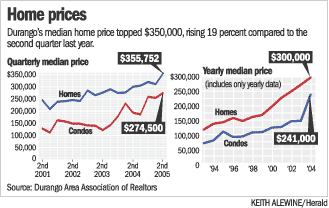 The median price of a home within Durango city limits increased almost 19 percent from $299,999 in the second quarter of 2004 to $355,752 in the second quarter of 2005. Meanwhile, county homes saw an increase from a $262,000 median price to $291,000, about 11 percent. The median price of county homes near Durango is $369,900, near Bayfield $254,000 and near Ignacio $208,000.
Subscribe to:
Posts (Atom)